
more hateration in this dancery, please
Behold! I have had a thought.
Hi!
Hello! I'm back in Britain and no longer spending all my days in the sun and also my throat and sinuses are mad at me because I smoked one million cigarettes in Morocco and I'm now vaping all day every day to try and make up for the nicotine deficit. No one has ever suffered more than me, in the entire history of humanity.
Generations to come will sing songs about my plight, they'll gather around the fire and speak of Marie, the most hard done by person to ever live. Oh also there's nothing I want to see at the cinema currently. Everything is awful, but at least we have nearly killed February, and soon it will be dead.
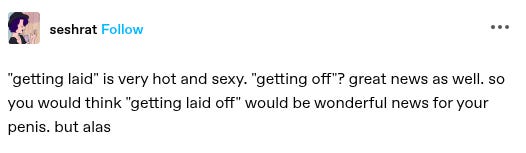
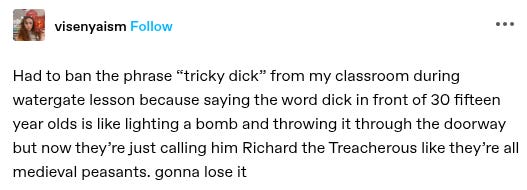
Here are some Tumblr posts I've enjoyed recently:
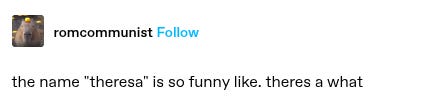
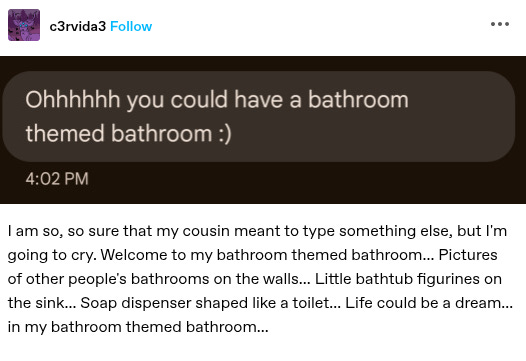
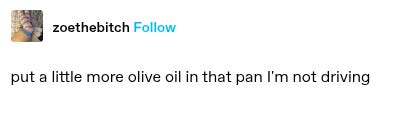
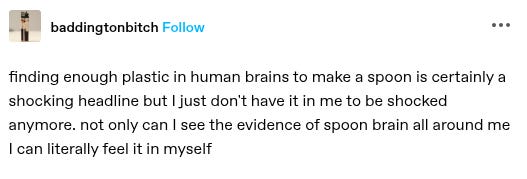
Ah and since I'm here, this piece by the lovely John Gallagher on the twinned histories of French and English is enchanting. I mean I would say that, obviously, given, you know, but still:
"Some researchers of the insular French spoken and written in England in the 13th and 14th centuries have argued that multilingualism was so ordinary in 14th-century England that not everyone would have had a reliable sense of the boundaries between the country’s different languages. They switched happily between English and French within the same document – sometimes even within the same sentence – in a way that suggests a lack of interest in where one language ended and the other began. And neither Anglo-French nor this multilingualism were literary affectations: it can be found being used alongside English and Latin in records of London guilds and trade, courtrooms and even the cries of 14th-century street sellers. Speaking French was a very English thing to do."
Enchanting!
A column

Obviously we're all still trying to figure out how this came to be. By "this", picture me waving in the general direction of both America and the internet. You know what "this" is. It's awful and it's inescapable. "This" has taken over our lives, but we're still not entirely sure what happened, so there's no way to know how to solve it. "This", in short, is both a pressing concern and a frustrating one.
I'm not going to pretend I have one large, smooth, shiny answer to offer, because no-one does, or at least I definitely don't. What I can do instead, and have been doing for a little while, is look at this gigantic, revolting knot and try to pick up some threads, and ask "well what's going on in this corner? What if I pulled on something, just to see what happens?". I did it a few weeks ago with identity politics, and already I'm coming back for more. There's no escaping from the knot.
The thread I'd like to pull on this week has to do with hating, and being a hater. Hating is something populism does well: all political movements will have in-groups and out-groups, to various extents, but populism is especially good at keeping those groups nebulous, and directing seemingly endless amounts of venom at whoever happens to be "them" that month. Populists are currently thriving, and they really are having a ball being haters. They're great at it. I sometimes wonder if they have a point or if, at the very least, we didn't accidentally create the conditions in which those haters were always going to thrive.
There's an essay from 2013 I go back to a lot, which you may know if you've been reading my stuff for a while, as I quote it at least once a year. I see it as one of the great foundational texts of the internet, and think about it often. It's "On Smarm" by Tom Scocca, and it was published by Gawker, back when Gawker was good. Well, at least I thought it was good; lots of people thought it was too nasty for its own good. I agree that it crossed the line sometimes, but I also think that a life without guilty pleasures is no life at all. Going too far also means that at least you're always trying something, which is better than not trying at all. Gawker kept us on our toes. BuzzFeed didn't.
This is, as it happens, how Scocca opened his essay:
"Last month, Isaac Fitzgerald, the newly hired editor of BuzzFeed's newly created books section, made a remarkable but not entirely surprising announcement: He was not interested in publishing negative book reviews. In place of "the scathing takedown rip," Fitzgerald said, he desired to promote a positive community experience."
That I couldn't tell you what BuzzFeed's book section ended up publishing is probably telling. As Scocca reminds us, BuzzFeed's motto was "no haters", as the website's overlords understood early on that "agreeability is popularity, and popularity is value". BuzzFeed wanted money, and so BuzzFeed would never be mean about anyone, ever, pinky promise, because people you're mean to, or about, are unlikely to read and share your stuff. It's fair to say that approach worked well for a while, to the extent that the rest of the online media ended up using BuzzFeed as a bit of a crib sheet. No-one quite knew how to do Journalism On The Internet, but they'd seemingly figured it out.